Average Reviews:

(More customer reviews)Are you looking to buy Beginning Chinese (Mandarin)--(Critical Languages Series)? Here is the right place to find the great deals. we can offer discounts of up to 90% on Beginning Chinese (Mandarin)--(Critical Languages Series). Check out the link below:
>> Click Here to See Compare Prices and Get the Best Offers
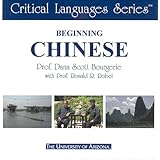
Beginning Chinese (Mandarin)--(Critical Languages Series) ReviewFirtsly, it feels as though this course was developed by a university Chinese department primarily as a supplement to the courses at their own university. I may be wrong, but that's how it feels. It is more of a text book on a CD Rom than a course that makes full use of the computer medium.One of the selling points of this course is undoubtedly the multi-media video clips that feature in each unit. They are so low-budget that they appear to be a gimmick, rather than a viable feature of the course. First of all they have been shot against what looks like a curtain loosely pinned on a board. When there are two people on the clip together you can quite clearly see the edges! However, most of the clips feature conversations between two or mor epeople, but hey only show one person speaking at a time! They seem to think that the viewer will find the fact that one person looks a little to the left, as though spekaing to someone who is on the left, and the other person doing the reverse, convincing! It isn't by any means. I am sure they could have done a lot more with these video clips if they had wanted to rather than just film 3 departmental staff in their everyday clothes, with the unconvincing addition of props like a book, a hat and even a telephone! Whoopee! A telephone! The clips feature 3 people - 2 women, one of whom is reasonably appealing and another one who, frankly, isn't! The third is a man who, on the second CD, looks as though he has just gotten out of bed, judging by the state of his hair. What are these video clips for? They may be of marginal use for seeing how the mouths look when sounds are being made, or they may help to focus concentration more on the task, but as they stand, they are a sorry addition to the program. It is almost laughable that, in the "how to use the course" instructions, we are told to look for "contextual clues" while viewing the video clips for the first time. What clues? Someone looking left and someone else looking right against a green background are not exactly useful, or even realistic clues to meaning! There is a unit on eating out - why didn't they at least order a take out and set it up round a table? It wouldn't exactly have broken the departmental budget, would it?
There is a separate section called "Supplemental materials" in the course which contains a range of subject-specific vocabulary items, all with sound. Good so far. However, this section also contains poems, games and tongue twisters all with sound and no text! You haven't got a clue what is going on! As for the toungue twisters, they are done by the less atractive of the two women, and the sounds just get uglier the faster they get. This video section is superflous!
Another negative point I found was the sound. Firstly, I had to call up the pinyin on occasion to hear exactly what the speaker was saying, as it just wasn't clear enough! Secondly, the pronunciation exercises are spoken exclusively by a female, so I found that I was having unnecessary difficulty trying to pitch my voice accordingly. Trying to convert her examples to my pitch range and learn the tones as well, just gets frustrating, and I have a good ear for languages! This problem could easily have been solved by having the option to have a male voice to repeat after, if desired. This is s failing of the course. The repeat and record feature of the course, is excellent, however, apart from having to confirm some of the intended sounds with the pinyin beforehand.
If you don't want to learn characters, then this course is not for you. While you can call up pinyin at the text reading stage, you are only presented characters when it comes to doing the exercises, which are undoable without the characters! That said, there is a good range of linguistically orientated tasks such as cloze-gap and flashcard drills, but if you are expecting a "Let's play a game!" approach that you get in a lot of software these days, then you are in for a disappointment. This is a very academic course, and, probably, all the better for it!
Is it worth getting? Although there are a few things to iron out, yes! It does not suffice as a stand-alone course, but it will supplement well any beginners text you are using (You will also need a text that covers characters), as explanations are really not full enough. For the price it is much better value than the awful Rosetta Stone courses! Finally, the spoken Chinese on this Rom is fast! You can slow it down so it goes word by word, another appealing feature, but at full speed, it is better of you know some Chinese first before you use this, as you may feel overwhelmed as a beginner.Beginning Chinese (Mandarin)--(Critical Languages Series) OverviewDespite the fact that they are spoken by millions of people, languages such as Korean or Turkish are not usually offered in schools or colleges. The Critical Languages Program (CLP) at the University of Arizona was created to meet the need for interactive instruction in these less-commonly-taught languages. In order to meet the needs of a wide variety of learners who wish to gain proficiency in some of these languages, CLP has developed a series of CD-ROM courseware beginning with Brazilian Portuguese, Cantonese, Kazakh, Korean, Mandarin Chinese, and Turkish. CD-ROMs for other less-commonly-taught languages are planned for the future. Each package contains two CD-ROMs with a total of twenty lessons for the beginning learner, consisting of video dialogues and readings by native speakers, thousands of audio recordings, graphics, and extensive notes. Handy browser features enable users to go back and review words and pronunciations and to access five types of exercises: multiple choice, fill-in-the-blank, audio flashcard, pronunciation, and listening dictation. These exercises enable users to test and improve their knowledge of each lesson. Learners with microphone-equipped computers can record and play back their own voices and then compare their pronunciation with that of the native speaker. With the click of a button, learners can hear native speakers pronounce words or phrases, facilitating quick comprehension of these challenging languages. Each package of two CD-ROMs contains the equivalent of a textbook and workbook with audio and video components, making it practical for either self-instruction or directed educational, governmental, and business purposes.Works on Windows 2000/XP/Vista/7. For more information, visit the UA Critical Languages Web site at http://clp.arizona.edu/cls/
Want to learn more information about Beginning Chinese (Mandarin)--(Critical Languages Series)?
>> Click Here to See All Customer Reviews & Ratings Now

0 comments:
Post a Comment