Average Reviews:

(More customer reviews)Are you looking to buy Politics, Language, and Time: Essays on Political Thought and History? Here is the right place to find the great deals. we can offer discounts of up to 90% on Politics, Language, and Time: Essays on Political Thought and History. Check out the link below:
>> Click Here to See Compare Prices and Get the Best Offers
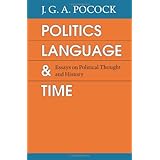
Politics, Language, and Time: Essays on Political Thought and History ReviewJGA Pocock's classic collection of essays, primarily encompassing the early modern world, recognize fully the importance of words as historical actors, and as analytic tools to understand arguments as they lay without doing antiquarian OR materialist violence to texts. His interest in discursive fields and the early modern text is more epistemologically rigorous than cultural studies, and more accessible than a great deal of poststructuralist work in this area. The general reader may not be interested in my technical comments, since plainly the essays in this volume are a joy to read for their own sake. Either theoretically or via the crystal-clear style of the author, Pocock leaves a reader coming away newly aware that "Language is Power."Politics, Language, and Time: Essays on Political Thought and History OverviewIn his first essay, "Languages and Their Implications," J. G. A. Pocock announces the emergence of the history of political thought as a discipline apart from political philosophy. Traditionally, "history" of political thought has meant a chronological ordering of intellectual systems without attention to political languages; but it is through the study of those languages and of their changes, Pocock claims, that political thought will at last be studied historically. Pocock argues that the solution has already been approached by, first, the linguistic philosophers, with their emphasis on the importance of language study to understanding human thought, and, second, by Thomas Kuhn's The Structure of Scientific Revolutions, with its notion of controlling intellectual paradigms. Those paradigms within and through which the scientist organizes his intellectual enterprise may well be seen as analogous to the worlds of political discourse in which political problems are posed and political solutions are proffered. Using this notion of successive paradigms, Pocock demonstrates its effectiveness by analyzing a wide range of subjects, from ancient Chinese philosophy to Machiavelli, Hobbes, and Burke.Want to learn more information about Politics, Language, and Time: Essays on Political Thought and History?
>> Click Here to See All Customer Reviews & Ratings Now

0 comments:
Post a Comment