Average Reviews:

(More customer reviews)Are you looking to buy How the Way We Talk Can Change the Way We Work: Seven Languages for Transformation? Here is the right place to find the great deals. we can offer discounts of up to 90% on How the Way We Talk Can Change the Way We Work: Seven Languages for Transformation. Check out the link below:
>> Click Here to See Compare Prices and Get the Best Offers
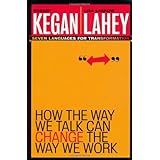
How the Way We Talk Can Change the Way We Work: Seven Languages for Transformation ReviewKegan and Lahey explain that their book "is about the possibility of extraordinary change in individuals and organizations. It locates an unexpected source of boundless energy to bring these changes into being" and then assert that "if we want deeper understanding of the prospect of change, we must pay closer attention to our own powerful inclinations not [italics] to change. This attention may help us discover within ourselves the force and beauty of a hidden immune system, the dynamic process by which we tend to prevent change, by which we manufacture continuously the antigens of change." I am convinced that most human limits are self-imposed...that in Pogo's words, "We have met the enemy and he is us." The authors do indeed focus on what they call "an unexpected source of boundless energy" which significant change requires.Throughout the book, they examine what they call "Seven Languages for Transformation" and suggest how to gain fluency in each. Four are Internal Languages: Commitment, Personal Responsibility, Competing Commitments ("Diagnosing the Immunity to Change"), and Assumptions We Hold ("Disturbing the Immunity to Change"). Fluency in these four enables us to build "The New Machine." There are also three Social Languages: Ongoing Regard, Public Agreement, and Deconstructive Criticism. Fluency in these three enables us to maintain and upgrade "The New Machine."
It is important to keep in mind that we communicate with others as well as with ourselves in three primary ways: body language, tone of voice, and content (ie what we verbalize). Decades of scientific research reveals that, in face-to-face contact, body language has the greatest impact, followed (at a significant distance) by tone of voice and then content. In voice-to-voice contact (eg during a telephone conversation), tone of voice has perhaps three times greater impact than does what is verbalized. I mention all this by way of suggesting that HOW we communicate with others and (especially) with ourselves has a major impact on behavior. Hence the importance of replacing a negative attitude. with a positive attitude. For example, to replace the Language of Complaint with the Language of Commitment.
What the authors provide is a cohesive and comprehensive process by which to recognize, understand, and then eliminate various barriers to personal and then to organizational change. In recent years, organizations throughout the world have invested hundreds of millions (billions?) of dollars in the improvement of systems of various kinds. What is sometimes overlooked or at least underestimated (at great cost in terms of hours as well as dollars) are the negative attitudes of those involved in change initiatives. Kegan and Lahey eloquently and convincingly suggest specific strategies to transform those attitudes through fluency in seven "languages" within the curriculum of what they view as a "new technology" of learning. Those who share my high regard for this book are urged to check out O'Toole's Leading Change and Senge's The Dance of Change.How the Way We Talk Can Change the Way We Work: Seven Languages for Transformation Overview"A genuinely 21st century book! Kegan and Lahey create a dynamic alternative to mere coasting on the momentum of the information age. Why do we know so much and yet so little lasting change actually occurs-in ourselves and in our organizations? This book doesn't just answer the question. It shows us a way out of the problem." -Michael Murphy, founder, Esalen Institute and author of The Future of the Body
Why is the gap so great between our hopes, our intentions, even our decisions-and what we are actually able to bring about? Even when we are able to make important changes-in our own lives or the groups we lead at work-why are the changes are so frequently short-lived and we are soon back to business as usual? What can we do to transform this troubling reality?
In this intensely practical book, Harvard psychologists Robert Kegan and Lisa Laskow Lahey take us on a carefully guided journey designed to help us answer these very questions. And not just generally, or in the abstract. They help each of us arrive at our own particular answers that can solve the puzzling gap between what we intend and what we are able to accomplish. How the Way We Talk Can Change the Way We Work provides you with the tools to create a powerful new build-it-yourself mental technology that allows you to:
Diagnose your own immunity to change
Unleash the boundless energy currently trapped in this immune system
Maintain and upgrade this state-of-the-art mental technology for lasting change.
The building blocks for this new technology are seven transformational languages, each permitting new kinds of thinking, feeling, and experiencing. Kegan and Lahey show us how we can use these languages-in our conversations with colleagues, friends, and as importantly, in the way we talk to ourselves-to transform:
Our complaints into commitments
Our blaming into responsibility
Our view of our own ineffectiveness into an understanding of its hidden genius
The assumptions we take as truths into exploreable, changeable ways of understanding ourselves and the world
Our tendency to praise and prize into deep-running ongoing regard
Social regulation by rules and personnel policies into the power of public agreement
Destructive and even constructive criticism into the bigger possibilities of "deconstructive criticism"
You'll want to read this book with pen in hand. The authors invite you in, not as an observer but as an active participant-to help you make powerful, lasting change in your life and the lives of those you seek to help or lead. The authors Robert Kegan, Ph.D., is the William and Miriam Meehan Professor of Adult Learning and Professional Development at the Harvard Graduate School of Education, and author of The Evolving Self and In Over Our Heads.
Lisa Laskow Lahey, Ed.D., is research director of the Change Leadership Project at the Harvard University Graduate of Education.
Advance praise for How the Way We Talk Can Change the Way We Work "Lucid, accessible, and immensely satisfying, this provocative book is plainly the product of a very deep understanding of why people behave the way they do. . . . an approach to change that is at once systematic and humane. . . . breakthrough thinking. . . compelling and inspiring." -Tony Schwartz, contribution editor, Fast Company, and author, What Really Matters
"A minor masterpiece. . . .In this simple brilliant book, Kegan and Lahey not only deal with the how of transformation. . . . they deal with the most central issue of all: how and why people (and organizations) are committed to not changing. . . . a must-read for all individuals and organizations that truly wish to grow into their own greater possibilities." -Ken Wilber, author, Integral Psychology
"By providing extraordinary practical wisdom, this book enables us to move from organizational frustration to collective achievement. An invaluable gem." -Ronald Heifetz, author, Leadership Without Easy Answers
"Maps both a personal transformative experience for the reader and the social arrangements that support this significant mode of adult learning. A unique and invaluable resource for adult educators, leaders in organizations, and every adult learner." -Jack Mezirow, emeritus professor of adult and continuing education, Teachers College, Columbia University
"Leaders trying to 'drive change' miss the deeper forces that might naturally enable it, forces which Kegan and Lahey reveal powerfully and practically." -Peter Senge, author, The Fifth Discipline: The Art and Practice of the Learning Organization
"This is a how-to-do-it book for reflective practitioners. Step by step, it teaches educators and leaders how to build highly collaborative, creative, and caring communities." -Mary Field Belenky, coauthor, Women's Ways of Knowing
"New, practical, and effective strategies for today's core leadership challenge: how to transform behavior in ourselves and others-without the debilitating crisis that is usually needed-by seeing and transcending the forces that hold us back." -Michael Jung, director, McKinsey & Company
Want to learn more information about How the Way We Talk Can Change the Way We Work: Seven Languages for Transformation?
>> Click Here to See All Customer Reviews & Ratings Now

0 comments:
Post a Comment