Showing posts with label arabic linguistics. Show all posts

First Arabic Reader bilingual for speakers of English: First Arabic Reader bilingual for speakers of English with bidirectional dictionary and on-line resources incl. audiofiles (Arabic Edition) Review

First Arabic Reader bilingual for speakers of English: First Arabic Reader bilingual for speakers of English with bidirectional dictionary and on-line resources incl. audiofiles (Arabic Edition)
Average Reviews:

(More customer reviews)
Are you looking to buy First Arabic Reader bilingual for speakers of English: First Arabic Reader bilingual for speakers of English with bidirectional dictionary and on-line resources incl. audiofiles (Arabic Edition)? Here is the right place to find the great deals. we can offer discounts of up to 90% on First Arabic Reader bilingual for speakers of English: First Arabic Reader bilingual for speakers of English with bidirectional dictionary and on-line resources incl. audiofiles (Arabic Edition). Check out the link below:

>> Click Here to See Compare Prices and Get the Best Offers

First Arabic Reader bilingual for speakers of English: First Arabic Reader bilingual for speakers of English with bidirectional dictionary and on-line resources incl. audiofiles (Arabic Edition) ReviewI believe this book could be a good addition to a beginner's arsenal for learning the language. But I was a bit surprised at the vocab to reading sample ratio. The publishers of this series claim that it uses the ALARM method, which is supposed to improve retention by allowing the reader to see the same words over and over again. Based on this claim, I expected the words from each vocab list, along with the previous words, to be repeated many times across several pages of reading before another vocab list is introduced. However, throughout the book the progression iterates between a page of 25-60 new words, followed by a mere 2 pages of reading. They do reuse the words from each list in the subsequent readings and as far as I can tell all words are repeated periodically (some more than others for obvious reasons), but I feel that the onslaught of new vocab makes it very difficult to retain all of the previously learned vocab. The author/publishers could have done well to have more reading samples between each vocabulary lists to allow for adequate retention. Also, the English translation is directly to the right of the sentence which I found to be both good and bad. I was initially quite annoyed by this as I wanted to be able to try and read/understand the passages for myself without the temptation to cheat. It's like trying to do a crossword puzzle with the answer on the same page, it's just too easy to look if you get stuck. But then, that's the point. The author/publishers want you to be able to see the translation so that you can understand the passage and really I found this to be quite helpful in the long run.
That being said, it is a useful book as the goal of improving reading comprehension and speed will be achieved (just don't expect any discussions on grammar or word/sentence structures cause none will be found). Also, the audio tracks are quite helpful (although a little fast, for my taste). Yet, here is another potentially negative point: only the audio tracks for the first 10 chapters are available on line from lppbooks.com,(which, incidentally is mentioned at the bottom of every page, so I don't know how the previous reviewer could have missed it). You will have to buy the additional tracks from the amazon website(there is a link on the lppbooks.com website right after the 10th track). They are grouped in to 5-6 chapter bundles for around $5 a piece, or you can buy them individually for $0.89 (which is nice, because you can buy each one individually as you get to that chapter). The whole set will cost you around $20.First Arabic Reader bilingual for speakers of English: First Arabic Reader bilingual for speakers of English with bidirectional dictionary and on-line resources incl. audiofiles (Arabic Edition) OverviewFirst Arabic Reader for beginners bilingual for speakers of English. The book consists of Elementary and Pre-intermediate courses. The author maintains learners' motivation with funny stories about real life situations such as meeting people, studying, job searches, working etc. The ALARM method (Approved Learning Automatic Remembering Method) utilize natural human ability to remember words used in texts repeatedly and systematically. The author had to compose each sentence using only words explained in previous chapters. The second and the following chapters of the Elementary course have only 29 new words each. All audio tracks are available on lppbooks.com for free download.

Want to learn more information about First Arabic Reader bilingual for speakers of English: First Arabic Reader bilingual for speakers of English with bidirectional dictionary and on-line resources incl. audiofiles (Arabic Edition)?

>> Click Here to See All Customer Reviews & Ratings Now
Read More...

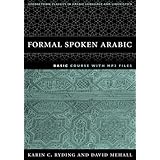
Formal Spoken Arabic Basic Course (Georgetown Classics in Arabic Language and Linguistics) Review

Formal Spoken Arabic Basic Course  (Georgetown Classics in Arabic Language and Linguistics)
Average Reviews:

(More customer reviews)
Are you looking to buy Formal Spoken Arabic Basic Course (Georgetown Classics in Arabic Language and Linguistics)? Here is the right place to find the great deals. we can offer discounts of up to 90% on Formal Spoken Arabic Basic Course (Georgetown Classics in Arabic Language and Linguistics). Check out the link below:

>> Click Here to See Compare Prices and Get the Best Offers

Formal Spoken Arabic Basic Course (Georgetown Classics in Arabic Language and Linguistics) ReviewThis is a great course. The dialogs in this course are interesting and sound similar to modern standard Arabic yet they have a more authentic feel. That seems to be the intent of the authors in their using an educated form of spoken Arabic. It is not as dialectal as pure amiyya, and it is not as formal as modern standard Arabic.
After learning a dialog one can go back and listen to it in its entirety without having to listen to one sentence spoken in Arabic and the next sentence in English and then back and forth in this manner. This a big plus for me. (There is only a little bit of recorded translation in the opening of the book.)
The lessons are very explanitive. The basic dialouges have detailed commentaries. Besides the audio, there is the text written in Arabic (no transliteration into English is found anywhere in the book), a detailed list of vocabulary, and sometimes the audio is given a second time at a slower pace so that one can repeat after the speaker.
The matrix dialouge is not explained at all, but it is made easier in that the subject matter is very similar to the basic dialouge's material. It is supposed to be hard, and it forces you to stretch out your ears a bit to try to catch all of the phrases. I found that the matrix dialouge is much easier after completing the unit that it is in, and it often contains the most natural sounding material.
There are also drills and grammar explanations. There are no answer keys for the drills, but they should be beneficial anyways.
Overall, this is arguably one of the best books for learning Arabic. One should have a fairly decent command of modern standard or classical Arabic before starting the course. (Don't attempt this book if you are a beginner.) It is good for building upon the knowledge of a literay form of Arabic in order to learn a spoken form. It doesn't teach any dialect of Arabic in particular. It is suppossed to be a somewhat neutral/educated form of speaking Arabic, but it does have somewhat of a Levantine feel to it at times.
Formal Spoken Arabic Basic Course (Georgetown Classics in Arabic Language and Linguistics) OverviewThis new edition, updated and with additional exercises, equips those who work, travel, and study in Arab countries with an educated form of spoken Arabic that functions flexibly in the face of various regional colloquial variants in the Arab world. Because the Arabic language has a number of very different spoken vernaculars, being able to speak and be understood in all Arab countries has become a challenge for English speakers. Ryding and Mehall have designed a course that teaches a standardized variant of spoken Arabic that is close to, but more natural than, the literary Modern Standard Arabic. With a non-grammar-based approach, this book fosters communicative competence in Arabic on all levels and develops speaking proficiency without abandoning Arabic script. It has proven to be clear, effective, and relevant to the needs of Americans living and working in the Arab East.Task-based lessons feature basic dialogues between Americans and Arabs, explanations of new structures, vocabulary expansion, and exercises; and provide gradual access to the sounds and script of Arabic by emphasizing listening and reading comprehension first, then slowly adding oral exercises and activities until the student has achieved basic proficiency. Not intended for self-instruction for beginners, "Formal Spoken Arabic Basic Course with MP3 Files" assumes some previous knowledge of Modern Standard Arabic, Arabic script and phonology, and previous or simultaneous instruction in orthography. This new edition includes a CD of MP3 audio exercises that are keyed to the text and drill students on listening and speaking. Lessons cover topics including: Heads of State; Cities and Countries; Official Titles; Geography; Systems of Government; Lost Luggage; Getting Acquainted; Establishing Common Ground; Seeking and Giving Information; Personal Needs and Family; Handling Problems; Eating Out; and, Bargaining and Buying.

Want to learn more information about Formal Spoken Arabic Basic Course (Georgetown Classics in Arabic Language and Linguistics)?

>> Click Here to See All Customer Reviews & Ratings Now
Read More...