Showing posts with label mind. Show all posts

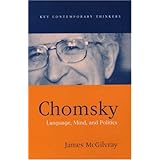
Chomsky: Language, Mind, and Politics (Key Contemporary Thinkers) Review

Chomsky: Language, Mind, and Politics (Key Contemporary Thinkers)
Average Reviews:

(More customer reviews)
Are you looking to buy Chomsky: Language, Mind, and Politics (Key Contemporary Thinkers)? Here is the right place to find the great deals. we can offer discounts of up to 90% on Chomsky: Language, Mind, and Politics (Key Contemporary Thinkers). Check out the link below:

>> Click Here to See Compare Prices and Get the Best Offers

Chomsky: Language, Mind, and Politics (Key Contemporary Thinkers) ReviewThis book gives a good overview of much of Chomsky's life work in linguistics, philosophy and politics. What it is not is an introduction into those topics, but neither is it written in a style that is overly academic. McGilvray seeks to integrate Chomsky's linguistic and political work somewhat and with a small amount of success, suggesting that they are intertwined and of course they are to a vague degree. That angle is interesting in its own way, but luckily the author does not force his hypothesis too much, instead he does a rather good job of overviewing and summarizing the main emphases of Chomsky's work in a cohesive and enlightening fashion. Probably not a necessary read for those who have read a lot of Chomsky's own works in both fields, but for those who haven't, or for people who simply enjoy reading in politics, philosophy and/or linguistics this book should make for interesting study.Chomsky: Language, Mind, and Politics (Key Contemporary Thinkers) OverviewThe key to Chomsky's overall intellectual project lies in what he has to say about a biologically based human nature.

Want to learn more information about Chomsky: Language, Mind, and Politics (Key Contemporary Thinkers)?

>> Click Here to See All Customer Reviews & Ratings Now
Read More...

The Stuff of Thought: Language as a Window into Human Nature Review

The Stuff of Thought: Language as a Window into Human Nature
Average Reviews:

(More customer reviews)
Are you looking to buy The Stuff of Thought: Language as a Window into Human Nature? Here is the right place to find the great deals. we can offer discounts of up to 90% on The Stuff of Thought: Language as a Window into Human Nature. Check out the link below:

>> Click Here to See Compare Prices and Get the Best Offers

The Stuff of Thought: Language as a Window into Human Nature ReviewThe Stuff of Thought: Language as a Window into Human Nature by Steven Pinker
Is there a difference between the meanings of these two sentences?
(1) Hal loaded hay into the wagon, and,
(2) Hal loaded the wagon with hay.
Well, Steven Pinker claims there is a difference and it's a difference that reveals something about the way the mind conceptualizes experience. That is "the stuff of thought" with which Pinker's latest book is concerned, and this "stuff," as he convincingly demonstrates, can be made accessible through a careful analysis of "the stuff of language," i.e., word categories and their syntactic habitats.
In the case of the two sentences above, we can see the human capacity to frame events in alternate ways through the dual function of verbs like "load." This verb draws attention to the hay and its movement in the first sentence, but to the transformation (a kind of metaphorical "movement") of the wagon in the second.
That children can learn the dual use of "load" and the dual conceptualizations that it entails, and distinguish this verb from others (like, say, toss) that don't work in both sentences (E.g., we don't say "Hal tossed the wagon with hay" even though we can say "Hal tossed the hay into the wagon") is evidence that distinct ways of thinking underlie our ability to master language. There are, after all, many thousands of verbs that fall into scores of different categories based on their applicability to different contexts like those involving Hal's hay in the cases above. Pinker believes that our ability to learn the subtle distinctions that control these and other word usages is evidence of their role as reflectors and enablers of the basic elements of human thought, elements like causality, animation, possession, time-as-space, and so on.
Pinker faces quite a challenge in bringing to life profound truths about human nature through a systematic, fine-grained analysis of mundane words like "drip" and "pour," but he succeeds admirably. This is a book that will amply reward a careful reading.
Of course some words are inherently more interesting than others, and for my money the chapter on "The Seven Words You Can't Say on Television" is by itself worth the price of the book. A number of features that help condemn a word to the realm of taboo are revealed here. For example, there are clear syntactic distinctions between the usually unprintable words for sex (which Pinker, I'm happy to report, audaciously prints) and their more presentable cousins, such as have sex, make love, sleep together, copulate, etc. I had never before noticed that the taboo and vulgar forms, which tend to specify physical motion, differ from the non-taboo terms in that they usually occur in a subject-verb-direct object construction (e.g., Austin shagged Vanessa). The more respectable terms lack a direct object and do not specify "a particular manner of motion or effect." Furthermore, they are semantically symmetrical, so that if Austin had sex with Vanessa, Vanessa also had sex with Austin. More fundamentally Pinker ties the cathartic effect of some swearing with "the Rage circuit, which [is]... connected with negative emotion." The Rage circuit, as part of the limbic system, is found in other animals and is associated with "a reflex in which a suddenly wounded or confined animal would erupt in a furious struggle to startle, injure and escape from a predator, often accompanied by a bloodcurdling yowl."
This is rich stuff, the drawing of a neat connection between a specific category of words and an emotional pattern linked to specific parts of the brain. This chapter also helps make sense of Tourette's syndrome and otherwise identifies swearing as "a coherent neurobiological phenomenon." Other chapters are similarly rewarding. Pinker's analysis of metaphors both expands on, and, to an extent, revises the classic works in this field by George Lakoff, Mark Johnson and others.
I have some quibbles with parts of Pinker's overall model, but this is to be expected with a work so ambitious and wide-ranging. I am surprised, for example, that Pinker doesn't mention the extensive work on cognitive prototypes by such authors as Brent Berlin and Eleanor Rosch since their research seems to overlap with his.
Another point: His arguments against connectionist models of language and thought I found to be not quite convincing. Here Pinker is arguing for a genetically-based set of neural patterns to explain the complexities of language, where connectionism points to a more flexible, post-natal learning system. Pinker demonstrates that connectionism is probably not adequate to explain language learning if one assumes (as he apparently does) that learning after puberty is just as permanent as that which is learned in childhood. But such an assumption is unwarranted, and if childhood learning does have a special durability, his criticism of connectionism loses its punch.
Also, in discussing social change (part of his analysis of changing tastes in the naming of children), he cites data indicating that most disappearances such as the end of hat-wearing among men in the 1960s, were the natural outcome of a long and steadily declining trajectory for this fashion. However, there are so many distinctly abrupt social changes that can be identified in this era (including such linguistic ones as the disappearance of the basic slang term "swell" and its replacement by "cool") that this argument for gradual social change leaves me skeptical.
Naturally these are the kinds of disputable points that a book like this is bound to stir up, and that's, of course, all to the good. All in all, Pinker has succeeded, once again, in writing a book which, while effectively tackling a very knotty set of issues, manages to be both accessible and engaging. Five stars.The Stuff of Thought: Language as a Window into Human Nature Overview

Want to learn more information about The Stuff of Thought: Language as a Window into Human Nature?

>> Click Here to See All Customer Reviews & Ratings Now
Read More...

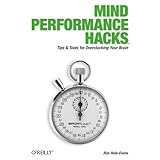
Mind Performance Hacks: Tips & Tools for Overclocking Your Brain Review

Mind Performance Hacks: Tips and Tools for Overclocking Your Brain
Average Reviews:

(More customer reviews)
Are you looking to buy Mind Performance Hacks: Tips & Tools for Overclocking Your Brain? Here is the right place to find the great deals. we can offer discounts of up to 90% on Mind Performance Hacks: Tips & Tools for Overclocking Your Brain. Check out the link below:

>> Click Here to See Compare Prices and Get the Best Offers

Mind Performance Hacks: Tips & Tools for Overclocking Your Brain ReviewThis book is based on information that can be found at the Mentat Wiki and consists of 75 tips and methods for helping you organize your thought processes and exercise your brain so that you think more efficiently. Some of them are well-known brain exercises, and some are not so well known. I had seen most of the memory hacks before, with the exception of the one on the "tip of the tongue" effect. In the section on creativity, I enjoyed the hack on looking at your brain as a random number generator that needs seeding by doing such tasks as picking up a magazine that you wouldn't normally look at and then reading it. I also liked the hack on learning Morse code like an efficiency expert. Although the task itself is of dubious value, the process teaches the reader the value of mnemonics which is, as the author puts it, is like putting Windows on top of DOS. The final chapter, on overall mental fitness, is of particular use to us baby-boomers as it reminds us not to neglect the essentials of basic overall physical health since this has a powerful effect on the brain. I really enjoyed this little book, since it has so many ways to expand your brain power and creativity that can easily be incorporated into your daily life.
The table of contents is not shown by Amazon, so I list the table of contents/hacks here:
Chapter 1. Memory
1. Remember 10 Things to Bring
2. Use the Number-Shape System
3. Make Lots of Little Journeys
4. Stash Things in Nooks and Crannies
5. Use the Major System
6. Use the Dominic System
7. Visit the Hotel Dominic
8. Dominate Your Memory
9. Memorize Numbers with Carroll's Couplets
10. Tune In to Your Memory
11. Consume Your Information in Chunks
12. Overcome the Tip-of-the-Tongue Effect
Chapter 2. Information Processing
13. Catch Your Ideas
14. Write Faster
15. Speak Your Brain's Language
16. Map Your Mind
17. Build an Exoself
18. Pre-Delete Cruft
Chapter 3. Creativity
19. Seed Your Mental Random-Number Generator
20. Force Your Connections
21. Contemplate Po
22. Scamper for Ideas
23. Deck Yourself Out
24. Constrain Yourself
25. Think Analogically
26. Enjoy Good, Clean Memetic Sex
27. Play Mind Music
28. Sound Your Brain with Onar
29. Keep a Dream Journal
30. Hold a Question in Mind
31. Adopt a Hero
32. Go Backward to Be More Inventive Going Forward
33. Spend More Time Thinking
34. Extend Your Idea Space with Word Spectra
Chapter 4. Math
35. Put Down That Calculator
36. Make Friends with Numbers
37. Test for Divisibility
38. Calculate Mental Checksums
39. Turn Your Hands into an Abacus
40. Count to a Million on Your Fingers
41. Estimate Orders of Magnitude
42. Estimate Square Roots
43. Calculate Any Weekday
Chapter 5. Decision Making
44. Foresee Important Problems
45. Predict the Length of a Lifetime
46. Find Dominant Strategies
47. Eliminate Dominated Strategies
48. Don't Overthink It
49. Roll the Dice
Chapter 6. Communication
50. Put Your Words in the Blender
51. Learn an Artificial Language
52. Communicate in E-Prime
53. Learn Morse Code Like an Efficiency Expert
54. Harness Stage Fright
55. Ask Stupid Questions
56. Stop Memory-Buffer Overrun
Chapter 7. Clarity
57. Learn Your Emotional ABCs
58. Avoid Cognitive Distortions
59. Use the Fourfold Breath
60. Meditate
61. Hypnotize Yourself
62. Talk to Yourself
63. Interview Yourself
64. Cultivate the Naive Mind
65. Employ Mental Momentum
Chapter 8. Mental Fitness
66. Warm Up Your Brain
67. Play Board Games
68. Improve Visual Attention Through Video Games
69. Don't Neglect the Obvious: Sleep, Nutrition, and Exercise
70. Get a Good Night's Sleep
71. Navigate Around the Post-Lunch Dip
72. Overclock Your Brain
73. Learn the Facts About Cognitive Enhancers
74. Snap Yourself to Attention
75. Assemble Your Mental Toolbox
Mind Performance Hacks: Tips & Tools for Overclocking Your Brain Overview
You're smart. This book can make you smarter.

Mind Performance Hacks provides real-life tips and tools for overclocking your brain and becoming a better thinker. In the increasingly frenetic pace of today's information economy, managing your life requires hacking your brain. With this book, you'll cut through the clutter and tune up your brain intentionally, safely, and productively.

Grounded in current research and theory, but offering practical solutions you can apply immediately, Mind Performance Hacks is filled with life hacks that teach you to:

Use mnemonic tricks to remember numbers, names, dates, and other flotsam you need to recall
Put down your calculator and perform complex math in your head, with your fingers, or on the back of a napkin
Spark your creativity with innovative brainstorming methods
Use effective systems to capture new ideas before they get away
Communicate in creative new ways-even using artificial languages
Make better decisions by foreseeing problems and finding surprising solutions
Improve your mental fitness with cool tricks and games

While the hugely successful Mind Hacks showed you how your brain works, Mind Performance Hacks shows you how to make it work better.


Want to learn more information about Mind Performance Hacks: Tips & Tools for Overclocking Your Brain?

>> Click Here to See All Customer Reviews & Ratings Now
Read More...