Showing posts with label philosophy. Show all posts

Media, Communication, Culture Review

Media, Communication, Culture
Average Reviews:

(More customer reviews)
Are you looking to buy Media, Communication, Culture? Here is the right place to find the great deals. we can offer discounts of up to 90% on Media, Communication, Culture. Check out the link below:

>> Click Here to See Compare Prices and Get the Best Offers

Media, Communication, Culture ReviewExplores fascinating, challenging and modern concepts and examples that academic and nonacademic readers can understand and appreciate. An inspiring way of thinking about the many connections among media, communication and culture. What makes this book so special is the original and provocative content and reader-friendly style. Lull guides the reader from basic concepts like ideology and the active media audience to sophisticated ideas like symbolic power, transculturation, and the superculture. This book sparks new ways of thinking globally about communication and culture and how media plays a role in both. Highly recommended.Media, Communication, Culture Overview

Want to learn more information about Media, Communication, Culture?

>> Click Here to See All Customer Reviews & Ratings Now
Read More...

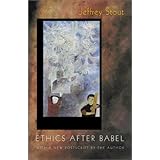
Ethics after Babel: The Languages of Morals and Their Discontents Review

Ethics after Babel: The Languages of Morals and Their Discontents
Average Reviews:

(More customer reviews)
Are you looking to buy Ethics after Babel: The Languages of Morals and Their Discontents? Here is the right place to find the great deals. we can offer discounts of up to 90% on Ethics after Babel: The Languages of Morals and Their Discontents. Check out the link below:

>> Click Here to See Compare Prices and Get the Best Offers

Ethics after Babel: The Languages of Morals and Their Discontents ReviewStout's book is a good discussion of how to choose the best among many choices in an increasingly relativistic world. I have used it to teach undergraduates comparative ethics and most of them found it useful and interesting, though not an easy read. It would be best suited to an upper level undergrad class and/or the lay reader who might have some background in ethical theory.
By far the most important idea in the book (to my mind) is that of the ethical bricolleur - the person who uses all at his/her disposal to develop a cogent ethic for his/her life in the context of their communities.
If you are looking for simple answers in ethics, this is not your text, but if you want a coherent, well reasoned discussion of the moral 'grey areas' we all need to traverse, Stout is a good choice.Ethics after Babel: The Languages of Morals and Their Discontents Overview

Want to learn more information about Ethics after Babel: The Languages of Morals and Their Discontents?

>> Click Here to See All Customer Reviews & Ratings Now
Read More...

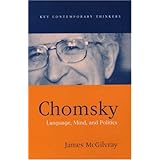
Chomsky: Language, Mind, and Politics (Key Contemporary Thinkers) Review

Chomsky: Language, Mind, and Politics (Key Contemporary Thinkers)
Average Reviews:

(More customer reviews)
Are you looking to buy Chomsky: Language, Mind, and Politics (Key Contemporary Thinkers)? Here is the right place to find the great deals. we can offer discounts of up to 90% on Chomsky: Language, Mind, and Politics (Key Contemporary Thinkers). Check out the link below:

>> Click Here to See Compare Prices and Get the Best Offers

Chomsky: Language, Mind, and Politics (Key Contemporary Thinkers) ReviewThis book gives a good overview of much of Chomsky's life work in linguistics, philosophy and politics. What it is not is an introduction into those topics, but neither is it written in a style that is overly academic. McGilvray seeks to integrate Chomsky's linguistic and political work somewhat and with a small amount of success, suggesting that they are intertwined and of course they are to a vague degree. That angle is interesting in its own way, but luckily the author does not force his hypothesis too much, instead he does a rather good job of overviewing and summarizing the main emphases of Chomsky's work in a cohesive and enlightening fashion. Probably not a necessary read for those who have read a lot of Chomsky's own works in both fields, but for those who haven't, or for people who simply enjoy reading in politics, philosophy and/or linguistics this book should make for interesting study.Chomsky: Language, Mind, and Politics (Key Contemporary Thinkers) OverviewThe key to Chomsky's overall intellectual project lies in what he has to say about a biologically based human nature.

Want to learn more information about Chomsky: Language, Mind, and Politics (Key Contemporary Thinkers)?

>> Click Here to See All Customer Reviews & Ratings Now
Read More...

The Stuff of Thought: Language as a Window into Human Nature Review

The Stuff of Thought: Language as a Window into Human Nature
Average Reviews:

(More customer reviews)
Are you looking to buy The Stuff of Thought: Language as a Window into Human Nature? Here is the right place to find the great deals. we can offer discounts of up to 90% on The Stuff of Thought: Language as a Window into Human Nature. Check out the link below:

>> Click Here to See Compare Prices and Get the Best Offers

The Stuff of Thought: Language as a Window into Human Nature ReviewThe Stuff of Thought: Language as a Window into Human Nature by Steven Pinker
Is there a difference between the meanings of these two sentences?
(1) Hal loaded hay into the wagon, and,
(2) Hal loaded the wagon with hay.
Well, Steven Pinker claims there is a difference and it's a difference that reveals something about the way the mind conceptualizes experience. That is "the stuff of thought" with which Pinker's latest book is concerned, and this "stuff," as he convincingly demonstrates, can be made accessible through a careful analysis of "the stuff of language," i.e., word categories and their syntactic habitats.
In the case of the two sentences above, we can see the human capacity to frame events in alternate ways through the dual function of verbs like "load." This verb draws attention to the hay and its movement in the first sentence, but to the transformation (a kind of metaphorical "movement") of the wagon in the second.
That children can learn the dual use of "load" and the dual conceptualizations that it entails, and distinguish this verb from others (like, say, toss) that don't work in both sentences (E.g., we don't say "Hal tossed the wagon with hay" even though we can say "Hal tossed the hay into the wagon") is evidence that distinct ways of thinking underlie our ability to master language. There are, after all, many thousands of verbs that fall into scores of different categories based on their applicability to different contexts like those involving Hal's hay in the cases above. Pinker believes that our ability to learn the subtle distinctions that control these and other word usages is evidence of their role as reflectors and enablers of the basic elements of human thought, elements like causality, animation, possession, time-as-space, and so on.
Pinker faces quite a challenge in bringing to life profound truths about human nature through a systematic, fine-grained analysis of mundane words like "drip" and "pour," but he succeeds admirably. This is a book that will amply reward a careful reading.
Of course some words are inherently more interesting than others, and for my money the chapter on "The Seven Words You Can't Say on Television" is by itself worth the price of the book. A number of features that help condemn a word to the realm of taboo are revealed here. For example, there are clear syntactic distinctions between the usually unprintable words for sex (which Pinker, I'm happy to report, audaciously prints) and their more presentable cousins, such as have sex, make love, sleep together, copulate, etc. I had never before noticed that the taboo and vulgar forms, which tend to specify physical motion, differ from the non-taboo terms in that they usually occur in a subject-verb-direct object construction (e.g., Austin shagged Vanessa). The more respectable terms lack a direct object and do not specify "a particular manner of motion or effect." Furthermore, they are semantically symmetrical, so that if Austin had sex with Vanessa, Vanessa also had sex with Austin. More fundamentally Pinker ties the cathartic effect of some swearing with "the Rage circuit, which [is]... connected with negative emotion." The Rage circuit, as part of the limbic system, is found in other animals and is associated with "a reflex in which a suddenly wounded or confined animal would erupt in a furious struggle to startle, injure and escape from a predator, often accompanied by a bloodcurdling yowl."
This is rich stuff, the drawing of a neat connection between a specific category of words and an emotional pattern linked to specific parts of the brain. This chapter also helps make sense of Tourette's syndrome and otherwise identifies swearing as "a coherent neurobiological phenomenon." Other chapters are similarly rewarding. Pinker's analysis of metaphors both expands on, and, to an extent, revises the classic works in this field by George Lakoff, Mark Johnson and others.
I have some quibbles with parts of Pinker's overall model, but this is to be expected with a work so ambitious and wide-ranging. I am surprised, for example, that Pinker doesn't mention the extensive work on cognitive prototypes by such authors as Brent Berlin and Eleanor Rosch since their research seems to overlap with his.
Another point: His arguments against connectionist models of language and thought I found to be not quite convincing. Here Pinker is arguing for a genetically-based set of neural patterns to explain the complexities of language, where connectionism points to a more flexible, post-natal learning system. Pinker demonstrates that connectionism is probably not adequate to explain language learning if one assumes (as he apparently does) that learning after puberty is just as permanent as that which is learned in childhood. But such an assumption is unwarranted, and if childhood learning does have a special durability, his criticism of connectionism loses its punch.
Also, in discussing social change (part of his analysis of changing tastes in the naming of children), he cites data indicating that most disappearances such as the end of hat-wearing among men in the 1960s, were the natural outcome of a long and steadily declining trajectory for this fashion. However, there are so many distinctly abrupt social changes that can be identified in this era (including such linguistic ones as the disappearance of the basic slang term "swell" and its replacement by "cool") that this argument for gradual social change leaves me skeptical.
Naturally these are the kinds of disputable points that a book like this is bound to stir up, and that's, of course, all to the good. All in all, Pinker has succeeded, once again, in writing a book which, while effectively tackling a very knotty set of issues, manages to be both accessible and engaging. Five stars.The Stuff of Thought: Language as a Window into Human Nature Overview

Want to learn more information about The Stuff of Thought: Language as a Window into Human Nature?

>> Click Here to See All Customer Reviews & Ratings Now
Read More...

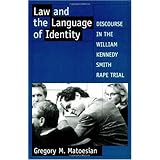
Law and the Language of Identity: Discourse in the William Kennedy Smith Rape Trial Review

Law and the Language of Identity: Discourse in the William Kennedy Smith Rape Trial
Average Reviews:

(More customer reviews)
Are you looking to buy Law and the Language of Identity: Discourse in the William Kennedy Smith Rape Trial? Here is the right place to find the great deals. we can offer discounts of up to 90% on Law and the Language of Identity: Discourse in the William Kennedy Smith Rape Trial. Check out the link below:

>> Click Here to See Compare Prices and Get the Best Offers

Law and the Language of Identity: Discourse in the William Kennedy Smith Rape Trial ReviewThis book is a masterpiece! As a practicing attorney and former English major, I have never seen such meticulous and detailed study of how lawyers and witnesses talk. I found it useful for my legal practice and just plain fascinating intellectually. I strongly recommend it for attorneys, legal scholars, and anyone interested in this case.Law and the Language of Identity: Discourse in the William Kennedy Smith Rape Trial OverviewIn this volume, Gregory Matoesian uses the notorious 1991 rape trial of William Kennedy Smith to provide an in-depth analysis of language use and its role in that specific trial as well as in the law in general.He draws on the fields of conversation analysis, ethnomethodology, linguistic anthropology and social theory to show how language practices shape--and are shaped by--culture and the law, particularly in the social construction of rape as a legal fact.This analysis examines linguistic strategies from both defense and prosecutorial viewpoints, and how they relate to issues of gender, sexual identity, and power.

Want to learn more information about Law and the Language of Identity: Discourse in the William Kennedy Smith Rape Trial?

>> Click Here to See All Customer Reviews & Ratings Now
Read More...

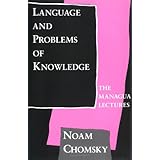
Language and Problems of Knowledge: The Managua Lectures (Current Studies in Linguistics) Review

Language and Problems of Knowledge: The Managua Lectures (Current Studies in Linguistics)
Average Reviews:

(More customer reviews)
Are you looking to buy Language and Problems of Knowledge: The Managua Lectures (Current Studies in Linguistics)? Here is the right place to find the great deals. we can offer discounts of up to 90% on Language and Problems of Knowledge: The Managua Lectures (Current Studies in Linguistics). Check out the link below:

>> Click Here to See Compare Prices and Get the Best Offers

Language and Problems of Knowledge: The Managua Lectures (Current Studies in Linguistics) ReviewReasonably quick read. Restates language as a side-effect of the brain's syntaxial approach in expressing thought.Language and Problems of Knowledge: The Managua Lectures (Current Studies in Linguistics) OverviewLanguage and Problems of Knowledge is Noam Chomsky's most accessiblestatement on the nature, origins, and current concerns of the field of linguistics.He frames the lectures with four fundamental questions: What do we know when we areable to speak and understand a language? How is this knowledge acquired? How do weuse this knowledge? What are the physical mechanisms involved in the representation,acquisition, and use of this knowledge?Starting from basic concepts, Chomskysketches the present state of our answers to these questions and offers prospectsfor future research. Much of the discussion revolves around our understanding ofbasic human nature (that we are unique in being able to produce a rich, highlyarticulated, and complex language on the basis of quite rudimentary data), and it ishere that Chomsky's ideas on language relate to his ideas on politics.The initialversions of these lectures were given at the Universidad Centroamericana in Managua,Nicaragua, in March 1986. A parallel set of lectures on contemporary politicalissues given at the same time has been published by South End Press under the titleOn Power and Ideology: The Managua Lectures.Noam Chomsky is Institute Professor ofLinguistics and Philosophy at MIT. Language and Problems of Knowledge is sixteenthin the series Current Studies in Linguistics, edited by Jay Keyser.

Want to learn more information about Language and Problems of Knowledge: The Managua Lectures (Current Studies in Linguistics)?

>> Click Here to See All Customer Reviews & Ratings Now
Read More...

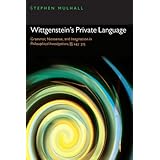
Wittgenstein's Private Language: Grammar, Nonsense, and Imagination in Philosophical Investigations, §§ 243-315 Review

Wittgenstein's Private Language: Grammar, Nonsense, and Imagination in Philosophical Investigations, §§ 243-315
Average Reviews:

(More customer reviews)
Are you looking to buy Wittgenstein's Private Language: Grammar, Nonsense, and Imagination in Philosophical Investigations, §§ 243-315? Here is the right place to find the great deals. we can offer discounts of up to 90% on Wittgenstein's Private Language: Grammar, Nonsense, and Imagination in Philosophical Investigations, §§ 243-315. Check out the link below:

>> Click Here to See Compare Prices and Get the Best Offers

Wittgenstein's Private Language: Grammar, Nonsense, and Imagination in Philosophical Investigations, §§ 243-315 ReviewMulhall reads parts of the Investigations resolutely, comparing at the same time with a possible substantive reading, and all the while adding the existential aspect to remind us of the importance of it all.Wittgenstein's Private Language: Grammar, Nonsense, and Imagination in Philosophical Investigations, §§ 243-315 OverviewStephen Mulhall presents a detailed critical commentary on sections 243-315 of Wittgenstein's Philosophical Investigations: the famous remarks on 'private language'. In so doing, he makes detailed use of Stanley Cavell's interpretations of these remarks; and relates disputes about how to interpret this aspect of Wittgenstein's later philosophy to a recent, highly influential controversy about how to interpret Wittgenstein's early text, the Tractatus Logico-Philosophicus, by drawing and testing out a distinction between resolute and substantial understandings of the related notions of grammar, nonsense and the imagination. The book is concerned throughout to elucidate Wittgenstein's philosophical method, and to establish the importance of the form or style of his writing to the proper application of this method.

Want to learn more information about Wittgenstein's Private Language: Grammar, Nonsense, and Imagination in Philosophical Investigations, §§ 243-315?

>> Click Here to See All Customer Reviews & Ratings Now
Read More...

Choice Words Review

Choice Words
Average Reviews:

(More customer reviews)
Are you looking to buy Choice Words? Here is the right place to find the great deals. we can offer discounts of up to 90% on Choice Words. Check out the link below:

>> Click Here to See Compare Prices and Get the Best Offers

Choice Words ReviewPeter Johnston's new book Choice Words - How Our Language Affects Children's Learning grew out of his work with exemplary teachers. For the past decade, Johnston and his colleagues have observed, interviewed, and reported on what makes an effective teacher. A key aspect of his research centers on the language teachers use in the classroom with their students. This thin, teacher-friendly volume is filled with excerpts from real classrooms and gives the reader a sense of eavesdropping on some of the best instruction in the country. Johnston turns the traditional idea of teacher as keeper-of-information on its head and invites the reader to consider the alternatives. Through a classroom community of social justice and democracy, children learn to question themselves and build agency as they emerge into the literate world.
Johnston's goal is to build a sense of agency within each student that ultimately adds to the larger classroom community. This idea of agency involves a child's sense of himself and his abilities. By developing the child's personal narrative of success, rehearsed frequently as a self-reminder and teaching tool for classmates, the teacher equips him with a knowledge and self-awareness that feeds on itself. The child becomes confident when new problems appear and moves through familiar steps of problem solving. Questions like "How did you figure that out?" and "What problems did you come across today?" underscore the idea that problems are not failures, but rather normal occurrences that can be overcome by using certain strategies. In addition to building these powerful narratives, teachers can reflect a child's knowledge through questions that solicit thorough explanations for what is known and draw connections between ideas. Questions like "How did you know that?", "How else . . . ?" and "How could we check?" enable students to articulate what they know and construct deeper meaning.
Trust me, it's a good one!Choice Words Overview
In productive classrooms, teachers don't just teach children skills: they build emotionally and relationally healthy learning communities. Teachers create intellectual environments that produce not only technically competent students, but also caring, secure, actively literate human beings.

Choice Words shows how teachers accomplish this using their most powerful teaching tool: language. Throughout, Peter Johnston provides examples of apparently ordinary words, phrases, and uses of language that are pivotal in the orchestration of the classroom. Grounded in a study by accomplished literacy teachers, the book demonstrates how the things we say (and don't say) have surprising consequences for what children learn and for who they become as literate people. Through language, children learn how to become strategic thinkers, not merely learning the literacy strategies. In addition, Johnston examines the complex learning that teachers produce in classrooms that is hard to name and thus is not recognized by tests, by policy-makers, by the general public, and often by teachers themselves, yet is vitally important.

This book will be enlightening for any teacher who wishes to be more conscious of the many ways their language helps children acquire literacy skills and view the world, their peers, and themselves in new ways.


Want to learn more information about Choice Words?

>> Click Here to See All Customer Reviews & Ratings Now
Read More...