Showing posts with label coaching. Show all posts

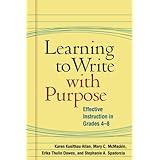
Learning to Write with Purpose: Effective Instruction in Grades 4-8 (Solving Problems in the Teaching of Literacy) Review

Learning to Write with Purpose: Effective Instruction in Grades 4-8 (Solving Problems in the Teaching of Literacy)
Average Reviews:

(More customer reviews)
Are you looking to buy Learning to Write with Purpose: Effective Instruction in Grades 4-8 (Solving Problems in the Teaching of Literacy)? Here is the right place to find the great deals. we can offer discounts of up to 90% on Learning to Write with Purpose: Effective Instruction in Grades 4-8 (Solving Problems in the Teaching of Literacy). Check out the link below:

>> Click Here to See Compare Prices and Get the Best Offers

Learning to Write with Purpose: Effective Instruction in Grades 4-8 (Solving Problems in the Teaching of Literacy) ReviewThe written word has to have a reason behind it or it is worthless. "Learning to Write With Purpose: Effective Instruction in Grades 4-8" is a guide for educators teaching elementary and middle school age students how to give their writing purpose and meaning. Writing is communication, and learning to use that communication to display thoughts and ideas is an absolutely invaluable skill. Packed cover to cover with advice for educators, "Learning to Write with Purpose" is a solid addition to community library education collections with a focus on language arts.Learning to Write with Purpose: Effective Instruction in Grades 4-8 (Solving Problems in the Teaching of Literacy) OverviewCommunicating ideas and information is what makes writing meaningful-yet many upper elementary and middle school students write in a vacuum, without considering the aims of their writing or the needs of their readers. This highly informative, teacher-friendly book presents a fresh perspective on writing instruction along with practical methods for the classroom. Teachers learn ways to promote the skills and strategies needed to write and revise effectively in a range of genres: personal narratives, fiction, and poetry; persuasive, explanatory, and "how-to" writing; and writing for high-stakes tests. Special features include vivid classroom vignettes, examples of student work, evaluation guidelines, and suggested "mentor texts" that model different genres.

Want to learn more information about Learning to Write with Purpose: Effective Instruction in Grades 4-8 (Solving Problems in the Teaching of Literacy)?

>> Click Here to See All Customer Reviews & Ratings Now
Read More...

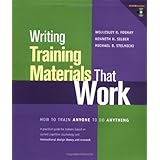
Writing Training Materials That Work: How to Train Anyone to Do Anything Review

Writing Training Materials That Work: How to Train Anyone to Do Anything
Average Reviews:

(More customer reviews)
Are you looking to buy Writing Training Materials That Work: How to Train Anyone to Do Anything? Here is the right place to find the great deals. we can offer discounts of up to 90% on Writing Training Materials That Work: How to Train Anyone to Do Anything. Check out the link below:

>> Click Here to See Compare Prices and Get the Best Offers

Writing Training Materials That Work: How to Train Anyone to Do Anything ReviewFoshay and associates have succeeded in the task described in the subtitle of this work. This book has three parts: 1. Introduction to the Cognitive Approach; 2. How to Design Lessons using the Cognitive Approach; 3. Using the Cognitive Approach: The Research Issues.
The book itself is an excellent illustration of the techniques that it intends to teach, starting with how to organize and present information (chapter 4). Then individual chapters deal with teaching facts (5), teaching concepts (6), teaching principles and mental models (7), teaching well-structured problem solving (8), teaching ill-structured problem solving (9), and teaching troubleshooting (10). The early chapters lay down the principles underlying the cognitive point of view on how learning occurs (1) and how to design training using the cognitive model described (2). The final chapters get into research issues related to teaching both declarative knowledge (13) and procedural knowledge (14) -- a critical distinction in the teaching of technology (my own area of interest) and for other areas of practical learning. Declarative knowledge is knowledge about something; procedural knowledge is knowledge of how to do something.
Strongly recommended.Writing Training Materials That Work: How to Train Anyone to Do Anything Overview

Want to learn more information about Writing Training Materials That Work: How to Train Anyone to Do Anything?

>> Click Here to See All Customer Reviews & Ratings Now
Read More...

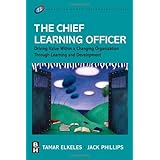
The Chief Learning Officer: Driving Value Within a Changing Organization Through Learning and Development (Improving Human Performance) Review

The Chief Learning Officer: Driving Value Within a Changing Organization Through Learning and Development (Improving Human Performance)
Average Reviews:

(More customer reviews)
Are you looking to buy The Chief Learning Officer: Driving Value Within a Changing Organization Through Learning and Development (Improving Human Performance)? Here is the right place to find the great deals. we can offer discounts of up to 90% on The Chief Learning Officer: Driving Value Within a Changing Organization Through Learning and Development (Improving Human Performance). Check out the link below:

>> Click Here to See Compare Prices and Get the Best Offers

The Chief Learning Officer: Driving Value Within a Changing Organization Through Learning and Development (Improving Human Performance) Review
Borrowing a phrase from Charles Dickens, for those involved in enterprise learning initiatives, these are "the best of times, the worst if times." Never before throughout human history has there been more and better information available than there is now, nor has it been easier to obtain or disseminate it. However, information needs are constantly and rapidly changing, especially in what has become (in Thomas Friedman's apt phrase) a "flat world," one without borders. Moreover, many executives have developed what Jeffrey Pfeffer and Robert I. Sutton so aptly characterize as a "knowing-doing gap." As a result, chief learning officers (CLOs) or their equivalent have an abundance of opportunities but they also face a number of significant challenges. In this volume, Tamar Elkeles and Jack Phillips provide information and counsel that suggest how to drive value within a changing organization through learning and development. They take various challenges into full account while responding to key questions such as these, devoting a separate chapter to each:
1. Insofar as the CLO is concerned, what are the most significant trends and issues?
2. How to devise a program that links strategy to learning?
3. How to set an appropriate investment level?
4. How to align the learning enterprise with business needs?
5. How to complete a transition to performance improvement?
6. How to create value-based delivery?
7. How to manage for value?
8. How to demonstrate and quantify the ROI of learning?
9. How to manage talent for value?
10. How to establish and then sustain productive management relationships?
Then in the final chapter, "The Voices of CLOs," Elkeles and Phillips include brief but insightful commentaries by 17 prominent chief learning officers, excerpted from interviews of them by Elkeles. (I wish it were possible to read each interview in its entirety.) "They are exceptional at what they do, well-known, and highly respected for their views. More importantly, they offer realistic perspectives about how the CLO function in the organization is managed. To varying degrees, the interviewees comment on some aspect of nine issues (listed on Page 287) that represent the focus of this book.
Readers will especially appreciate Elkeles and Phillips' skillful use of various reader-friendly devices, notably the provision of Figures (e.g. Figure 1-1, "CLO Roles to meet business challenges," Page 3), Tables (e.g. Table 3-2, "Turnover Cost Categories," on Page 62 and Table 5-4, "Core Competencies Associated with Performance Improvement Work," on Page 120), dozens of boxed quotations inserted throughout the narrative that are relevant to the given context, a "Final Thoughts" section at the conclusion of most chapters, and dozens of Checklists (e.g. "Steps for Needs Assessment and Analysis" on Page 98 and "Benefits of Management Involvement" on Page 276). These and other devices will facilitate, indeed accelerate a review of key points long after the book has been read.
Although this book was primarily written for chief learning officers (with or without a formal title), I think it is also a "must read" for other C-level executives and especially for board members and CEOs. I agree with Peter Drucker that everyone involved in an organization (whatever its size or nature may be) must be knowledge workers. Only then can effective leadership be developed at all levels and in all areas, thereby ensuring that the organization can achieve and then sustain a competitive advantage. The combined costs of failing to do that are incalculable. Hence my selection of Derek Bok's comment to serve as the title of this review.
Congratulations to Tamar Elkeles and Jack Phillips on a brilliant achievement.
Those who share my high regard for this book are urged to check out Jay Cross's Informal Learning: Rediscovering the Natural Pathways That Inspire Innovation and Performance as well as Return on Learning: Training for High Performance at Accenture co-authored by Donald Vanthournout and his associates on Accenture's Capability Development team. Also Edward Lawler's Talent: Making People Your Competitive Advantage, Also, John Hager and Paul Halliday's Recovering Informal Learning: Wisdom, Judgement and Community, Dean Spitzer's Transforming Performance Measurement: Rethinking the Way We Measure and Drive Organizational Success, and Enterprise Architecture as Strategy: Creating a Foundation for Business Execution co-authored by Jeanne W. Ross, Peter Weill, and David Robertson.The Chief Learning Officer: Driving Value Within a Changing Organization Through Learning and Development (Improving Human Performance) Overview

Want to learn more information about The Chief Learning Officer: Driving Value Within a Changing Organization Through Learning and Development (Improving Human Performance)?

>> Click Here to See All Customer Reviews & Ratings Now
Read More...

Reading the Web: Strategies for Internet Inquiry (Solving Problems in the Teaching of Literacy) Review

Reading the Web: Strategies for Internet Inquiry (Solving Problems in the Teaching of Literacy)
Average Reviews:

(More customer reviews)
Are you looking to buy Reading the Web: Strategies for Internet Inquiry (Solving Problems in the Teaching of Literacy)? Here is the right place to find the great deals. we can offer discounts of up to 90% on Reading the Web: Strategies for Internet Inquiry (Solving Problems in the Teaching of Literacy). Check out the link below:

>> Click Here to See Compare Prices and Get the Best Offers

Reading the Web: Strategies for Internet Inquiry (Solving Problems in the Teaching of Literacy) ReviewI was required to read this book for a class I was taking. At first glance I thought it would be "just another textbook." However, I quickly realized what a goldmine of information and guidance the book delivers. It takes a huge concept and breaks it down into readily usable applications. Too often I will find great theory resources, but they will lack the day-to-day nitty gritty of application. This book has the theory, the steps, the handouts, even the lesson plans. I found the readability engaging and direct. Great resource and great introduction into the miasma of inquiry-based research and 21st literacy skills. Thank you, Drs. Eagleton and Dobler, you have given me a launch into a whole new curriculum!Reading the Web: Strategies for Internet Inquiry (Solving Problems in the Teaching of Literacy) OverviewPacked with ideas and instructional activities that cut across all content areas, this engaging book provides a comprehensive framework for promoting vital Web literacy skills in grades 3-8. Teacher-friendly special features include helpful graphics, sidebars, practical tips, and nearly 100 reproducibles. Using a research-based, classroom-tested model of Internet inquiry, the authors explain the "whats," "whys," and "how-tos" of helping diverse learners: *Locate useful information sources on the Web*Navigate the contents of a website*Critically evaluate what they read online*Synthesize the results of an Internet inquiry*Express new knowledge in their own words

Want to learn more information about Reading the Web: Strategies for Internet Inquiry (Solving Problems in the Teaching of Literacy)?

>> Click Here to See All Customer Reviews & Ratings Now
Read More...

Using Picture Books to Teach Writing With the Traits: K-2: An Annotated Bibliography of More Than 150 Mentor Texts With Teacher-Tested Lessons Review

Using Picture Books to Teach Writing With the Traits: K-2: An Annotated Bibliography of More Than 150 Mentor Texts With Teacher-Tested Lessons
Average Reviews:

(More customer reviews)
Are you looking to buy Using Picture Books to Teach Writing With the Traits: K-2: An Annotated Bibliography of More Than 150 Mentor Texts With Teacher-Tested Lessons? Here is the right place to find the great deals. we can offer discounts of up to 90% on Using Picture Books to Teach Writing With the Traits: K-2: An Annotated Bibliography of More Than 150 Mentor Texts With Teacher-Tested Lessons. Check out the link below:

>> Click Here to See Compare Prices and Get the Best Offers

Using Picture Books to Teach Writing With the Traits: K-2: An Annotated Bibliography of More Than 150 Mentor Texts With Teacher-Tested Lessons ReviewIt's here! This is a teaching resource you won't want to be without. New to the traits? This book provides you with a definition of each trait that's user-friendly for teachers and young children. What follows is an annotation of a number of picture books that can be used for the trait. As if that isn't enough, each of the six main traits has three focus lessons and follow-up activities to get you going. For those of us that love teaching with the traits and use them faithfully, this book is an energizer. You'll find new picture books to add to your collection, plus old favorites with new ideas on how to use them.
As a resource person in my school, I'm often asked to do a lesson at the last minute. No problem! I pull out this magic book, look through the lesson, grab a picture book, and I'm good to go. Classroom teachers love the user-friendliness just as much as I do.
Ruth and Ray are to be applauded. In this age of test scores, change, and everything else that's going on, Using Picture Books to Teach Writing With the Traits is a breath of fresh air. It simplifies our teaching lives while making it exciting and fun for teachers and children alike.
Thank you, Ruth and Ray, for yet another excellent teaching resource!Using Picture Books to Teach Writing With the Traits: K-2: An Annotated Bibliography of More Than 150 Mentor Texts With Teacher-Tested Lessons OverviewGood teachers have long recognized the power of using picture books as models of good writing. The short, focused, and tightly woven text mirrors the kind of writing they want their students to be doing. In this essential resource, the authors have organized by trait more than 150 annotations of new and classic books that will delight young studentsNand inspire powerful writing. Peppered throughout are 18 step-by-step, trait-focused lessons based on specific books.For use with Grades K-2.

Want to learn more information about Using Picture Books to Teach Writing With the Traits: K-2: An Annotated Bibliography of More Than 150 Mentor Texts With Teacher-Tested Lessons?

>> Click Here to See All Customer Reviews & Ratings Now
Read More...

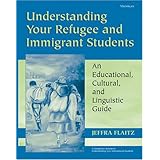
Understanding Your Refugee and Immigrant Students: An Educational, Cultural, and Linguistic Guide (Michigan Teacher Resource) Review

Understanding Your Refugee and Immigrant Students: An Educational, Cultural, and Linguistic Guide (Michigan Teacher Resource)
Average Reviews:

(More customer reviews)
Are you looking to buy Understanding Your Refugee and Immigrant Students: An Educational, Cultural, and Linguistic Guide (Michigan Teacher Resource)? Here is the right place to find the great deals. we can offer discounts of up to 90% on Understanding Your Refugee and Immigrant Students: An Educational, Cultural, and Linguistic Guide (Michigan Teacher Resource). Check out the link below:

>> Click Here to See Compare Prices and Get the Best Offers

Understanding Your Refugee and Immigrant Students: An Educational, Cultural, and Linguistic Guide (Michigan Teacher Resource) ReviewIt's been a while since I read this, so my memory's not fresh, but it made a great impression on me. I loved the information on classroom etiquette in other cultures. Now I understand better why some students seem shy, or bring gifts, or cover their mouths when they talk. I also appreciated the lists of useful phrases in different languages. I plan to get this book from the library again, and would love to own it.
**Update** I like this so much, but it's getting more and more out of date. I wish it covered recent political developments affecting immigration, and several countries that I'm surprised aren't represented at all. One idea is to have my advanced students do a project of creating mini-chapters (or updates) on their own countries following the model of this book. Sharing the results as a class should be interesting to the diverse group of students, as well. Still a great book, with each chapter focusing on a particular country; easy to pick and choose the chapters most relevant to you.Understanding Your Refugee and Immigrant Students: An Educational, Cultural, and Linguistic Guide (Michigan Teacher Resource) OverviewUnderstanding Your Refugee and Immigrant Students is an excellent resource for educators who work with refugees and immigrants.This well-researched volume-including interviews with students from the profiled countries-provides a wealth of information about the specific schooling traditions, practices, circumstances, and expectations that follow these individuals to their new homes in North America and influence their learning experience. The author has focused her research on 18 countries that contribute a majority of refugees and immigrants to the United States:Afghanistan, Bosnia-Herzegovina, Croatia, the Dominican Republic, Ecuador, El Salvador, Ethiopia, Guatemala, Honduras, India, Iran, Laos, Liberia, Peru, Somalia, Sudan, and the Ukraine. Each country profile features: statistics about the country, a historical synopsis, an overview of the county's official education policy, cultural perspectives, and a problem-solution section containing classroom strategies.The linguistic systems of the languages featured are also included for teacher reference.Also included is information about teacher-student relationships, discipline and class management, and appropriate non-verbal communication.This volume provides invaluable insight into refugee and immigrant students' cultural and educational backgrounds and gives instructors the tools to translate this information into effective classroom strategies.

Want to learn more information about Understanding Your Refugee and Immigrant Students: An Educational, Cultural, and Linguistic Guide (Michigan Teacher Resource)?

>> Click Here to See All Customer Reviews & Ratings Now
Read More...